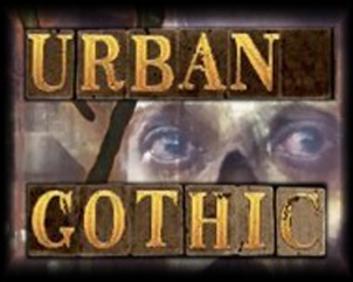
The Gothic in Thirty Minutes
There are so many words that can exude vivid imagery, but none more so than ‘gothic’. An aesthetic, as much as it is a tone and atmosphere. Poe and Byron, who set the bar for that frilly terminology, where the words have texture, vibrancy, a literate darkness that transforms you. The term gothic itself is about transporting your mood into a space that is both liminal and visceral simultaneously.
My take was this: what will be new and exciting for the audience of Gothic Revival is whether we take an example of modern storytelling. I come from a world where I explore creators’ visions through play — video games, the tactile and touchable. Castlevania, Bloodborne, The Life of P — these are modern gothic storytelling, and they could be future articles. But where I want to take it today is personal.
There was a time in my late teens when I very nearly almost… became a goth. I was discovering who I was — I had longer dark hair, the interest in the esoteric and the wonder of the what is causing those knocks on the walls. The weird space between punk rock and music discovery. A TV show had started airing on Channel 5 called Urban Gothic, and it came along at exactly the right time. I didn’t take on the gothic character, though I did buy a frilled shirt from Nottingham’s Ice Nine — or was it Void Clothing, across the road? Whilst I didn’t embrace the gothic persona and hang around the Market Square listening to My Immortal by Evanescence. My mind did.
I’ve always had a passion for how stories are told, and the setting in which they’re told. Within a poem, a play, a short narrative — half an hour, even just a sentence — these can all embody the palpable of gothic. Gothic compressed into thirty minutes.
On Channel 5 at that time, I discovered the show that was greenlit almost instantly when it was proposed — created by Tom de Ville, a filmmaker who had just left film school. Urban Gothic. I watched maybe two or three episodes on its initial airing, and caught sporadic episodes after that. It had a really late time slot, around eleven o’clock at night, and with work I never caught every episode. Back around 2006, I saw it on DVD in a shop, picked it up relatively cheaply, and have done a watch-through of a couple of times of the episodes since.
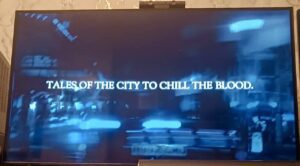
Let’s dive into the tales of the city that chill the blood. London is a facade — everyone in smart suits and Rolex watches, trying to fit the modern London aesthetic. But beneath that are forgotten corners, dark secrets, underneath the designer boutiques and coffee bars. There’s a subtlety that’s strange and unusual, where anything can happen, and being young or pretty won’t save you. That’s the encapsulation of the show. Everyone is in that early-twenties-to-thirty dynamic. It’s shot on a low TV budget, which actually helps the aesthetic. It sits around the year 2000 — moving away from the cheesy, bubbly lines of the nineties; productions were not quite at the proper gritty television yet; we haven’t reached that point. It occupies that transitional place in between what Black Mirror would come to inhabit much later.
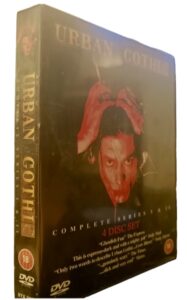
The first season comprises thirteen half-hour episodes, an anthology where every episode is individual — no overarching story, though threads are being weaved. Inside it: vampire documentaries, alien-infested supermarkets, teenage necromancy, ghostly East End gangsters. The DVD box set contained behind-the-scenes stuff — inspirations from the cannibal killers to the darkest of teen love stories — and a secret conspiracy happening behind all the horrors.
I recently dived into three episodes of season one. The cast is intriguing — predominantly fresh British young actor faces alongside supporting stage and screen stalwarts: Leslie Grantham, Lindsay Coulson, Richard O’Brien, Sean Maguire, some actors playing in more than one episode. The first episode, Dead Meat, sets the stage: a bunch of friends, quite young and naive, and it comes across because you’re watching them as actors, clearly on their first jaunt to success. That element adds a gothicness of its own — stepping into a space where you have no idea where it might lead, enveloped in a world saturated with dark macabreness for the very first time. It’s intriguing to see the characters and the series take those steps together, their intention being to bring a corpse back to life.
Vampirology is a mock documentary on the life of a vampire — now that I’ve watched the first season in its entirety, perhaps the best episode. Old Nick is a story of a murderous boy who discovers he’s the devil. Lacuna. Deptford Voodoo, about voodoo in the innercity suburbs, a home invasion and attack during a ritual kicks off a sequence of events. The One Where… — each of the group of friends has their desires fulfilled by Lucien, a devil-like entity who seeks to tempt each one of the group into committing an act of violence or murder. The episode that isn’t considered one of the strongest but is certainly one of the most disturbing — if it had more time to flourish— is Sum of the Parts. The spirit of this evil woman comes to collect her organs, which have been distributed to patients, with first-person perspective sequences and a police investigation following the murders. With another layer of twisted bioengineering occurring in the basement of the hospital.
Every episode features nudity, sex, graphic violence, and a punk London aesthetic throughout. Cry Wolf is a modern urban retelling of a lady who falls in love with a werewolf. B-Movie is a group of students trapped in a horror film, with only one survivor. The Boy’s Club is about Lenny Scratch, a man who desires to be accepted as a hard man and finds himself having to sacrifice his father. The next episode turns the narrative on its head: Pineapple Chunks, about pineapple-powered aliens. It’s not very good, but that’s the point — it’s quite funny, quite visceral, shot cheaply, and looks like a bad episode of Red Dwarf while trying to formulate its own character and narrative space. With two strong episodes: Turn On, about a robot that thinks she’s a woman — which we now see replicated through many cyberpunk shows, humans and robots trying to understand their own existence. And the last episode, Thirteen, is where the season earns its title. A year has passed since Dead Meat, and Jude Redfield — the frustrated reporter we met in that opening episode — is chosen as the next Storyteller of London. Richard O’Brien plays the Storyteller himself, the keeper of the city’s dark tales, and the handover is the season’s quiet masterstroke: the man who spent thirteen episodes chasing stories discovers he was always meant to tell them. It’s a gothic ending in the truest sense — the city itself choosing its chronicler, passing the mantle from one voice to another like a secret handed down through generations. The urban gothic isn’t just a genre here. It’s a lineage.
A real visceral season one, exploring the different facades of what gothic can possibly be, the tones of what that could be. Rough around the edges, but entertaining. Clearly a show of its time, the quality acting and the scripts vary, which lends to it — people exploring those topics for the very first time, adding a flavour that makes it above average.
There’s a style and substance with a wrapping of grungy Britpop with a touch of neon. Telling stories that are modern and recurringly dark, where the desires of the human mind are always at play, and exploring various ways to get into the tapestry of acts that are all so gothic.
Support Kristian here:
https://ko-fi.com/kristianlander

Kristian Lander
Kristian Lander is a writer, digital creator, filmmaker, and editor and is well-known throughout the paranormal scene by producing weekly webinars for ASSAP (Association for the Scientific Study of Anomalous Phenomena) and producing the Seriously Strange magazine.